
By: Amy O’ Brien | Link to article
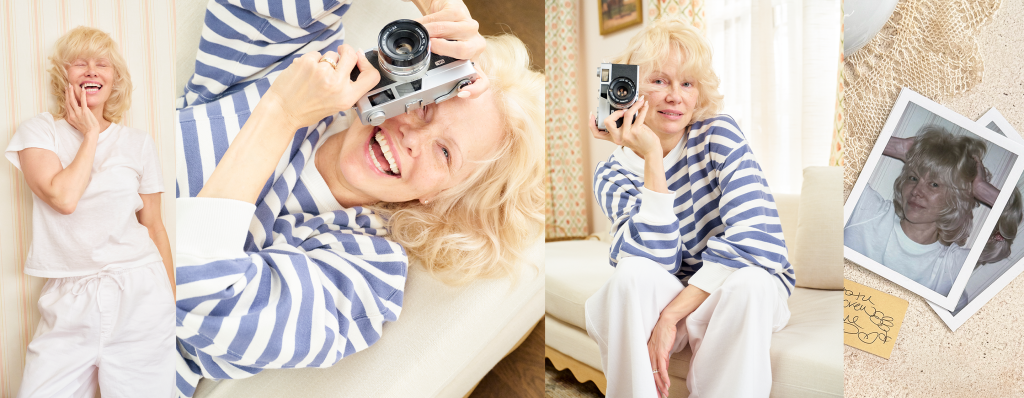
What does “real” mean in the AI era? For Aerie, American Eagle Outfitter’s loungewear and lingerie brand, realness is entirely human — untouched or altered by AI. As consumers and brands wrestle with how to approach the rapidly advancing tech, the brand is taking a stance against it. In October last year, Aerie expanded its “100% Aerie Real” anti-retouching pledge to never use AI-generated bodies or people in their marketing. And today, the brand is taking it one step further with the release of a bold new anti-AI film campaign, starring untouched beauty advocate Pamela Anderson.
What does “real” mean in the AI era? For Aerie, American Eagle Outfitter’s loungewear and lingerie brand, realness is entirely human — untouched or altered by AI. As consumers and brands wrestle with how to approach the rapidly advancing tech, the brand is taking a stance against it. In October last year, Aerie expanded its “100% Aerie Real” anti-retouching pledge to never use AI-generated bodies or people in their marketing. And today, the brand is taking it one step further with the release of a bold new anti-AI film campaign, starring untouched beauty advocate Pamela Anderson.
“I thought it was a clever way to draw attention to [AI images] because it’s very worrisome,” Anderson tells Vogue. “To me, as a woman, as a consumer, as a mother, I always think, what is happening? What is the difference between AI and real? How are we supposed to know? It was already disheartening at times to look at fashion magazines and see celebrities and models with retouching, but this is another level.”
Ever since appearing at Paris Fashion Week makeup-free in 2023, Anderson has become a leading voice for natural beauty and ageing authentically. In the film, which will live across Aerie’s social channels, as well as placements on YouTube, Amazon Prime, Netflix, Disney, and HBO, her voice acts as the prompting force issuing commands into a supposedly AI-generated world, unable to achieve the authentic human “real-feeling” result she wants from a scene with lifeless models. The scene then dissolves into a “real” Aerie set, where the models come alive, and Anderson appears before the camera to say: “You can’t prompt this.”
A large part of luxury marketing is amping up its messaging around craft, process, and humanity, with brands like Loewe, Bottega Veneta, Jacquemus, and Miu Miu all centering their recent campaigns around these values and showcasing the handmaking processes behind their products. Another tranche have leaned into AI imagery — most recently Prada, via its Spring/Summer 2026 campaign with artist Jordan Wolfson, as well as Gucci and Valentino — but faced backlash from creatives and consumers online. Aerie, however, is one of the first fashion brands to adopt an explicit anti-AI stance as the central message in its marketing. It’s a bold tactic that seems to be resonating with consumers. The brand dropped its first “real people” anti-AI Instagram campaign in October last year, which quickly went viral.
“Since we soft-launched the anti-AI message in October, we’ve seen double-digit growth in brand awareness,” says Stacey McCormick, Aerie’s Chief Marketing Officer. The Aerie brand reported a 23% increase in sales in the fourth quarter of 2025. “We’ve also seen a very strong shift in our awareness and consideration.”
I sit down with Pamela Anderson and Stacey McCormick to find out more about the new film, and the branding strategy behind Aerie’s anti-AI marketing pledge.
Vogue: We live in a world where you open up Instagram and you’re unsure if what you’re seeing is real or AI. What’s your take on what that’s doing to young people’s views on beauty standards?
Pamela: I think you have to create your own beauty standards. I mean, why do we want to look like other people? It’s all subjective. What is beauty? I’m almost 60 years old. I’ve gone through my life lessons, but I am happier now after peeling it back. It’s still a process and a practice to be self-accepting. In a digital world, it’s even harsher than back in the day when things were filmed. What you see to the naked eye isn’t even what you see on your camera phone. So we’re all being hypercritical of ourselves, and I think we need to do less of that.
I don’t mind taking one for all of womenkind. I’m not retouching or filtering. This is just what it is, and it’s so freeing. It’s so much more interesting to look perfectly imperfect. I like to align myself with brands who are trying new things and the messaging has to be something more than just selling clothes or selling a brand. I just really want it to be educational and inspirational in some way.
Stacey: The other part for us is the impact on mental health, and the negative impact on self-esteem and confidence. It’s almost like it’s completely flipped, where we thought we were making so much progress with challenging artificial beauty standards, and then AI happens. How do you even compete with a fake, AI-generated model? The impact on youth and anybody consuming that content is real. So we advocate for others to join us and to help preserve real content and real beauty and show up in a real space, to help as consumers are now navigating the world of AI-generated content.
Vogue: It’s interesting what you say about the subjectivity of beauty, because a lot of the AI imagery we see is trained on very polished stock or editorial campaign images. What’s your view on what this convergence means for consumers and professional models?
Pamela: We always romanticize our golden years, but I remember in the ’90s — everyone looked different. But over the last few years, it’s like, wow, we’re starting to look the same. So I think it’s rebellious to just look like yourself and really double down on that and not fall into the trappings, which is hard when you’re young.
That’s why I thought this campaign is a much-needed conversation. I’m an analog girl, I have my transistor radio that I listen to. There’s so many little things you can do like that, which help to not kind of get sucked up by the machine. And so drawing attention to things like this is important because it’s eye-opening, friendly, and accepting. I can’t even imagine being a young person in these times. So as long as you’re aware of where AI is used, then you can make better choices.
Vogue: We’re in a phase of lots of AI image experimentation. Do you think the consumer actually wants that? Do you reckon more are going to make a stance like Aerie’s?
Pamela: I don’t think you can ever replace human beings. Maybe AI will start becoming imperfect like humans. That would be scary. But you can’t replace human beings, and I feel like there will not necessarily be pushback. The only person you can control is yourself and in your own small way, you can make a stand for what you believe in. How boring would it be if everything was just perfect? It’s all subjective, and you’ve got to imprint yourself with unique things. Go to museums, galleries, watch old movies. You’ve got to kind of balance it all out with the AI you’re being subjected to.
Stacey: My gut tells me that as long as this younger generation continues to value transparency and trust and authenticity, AI is not going to make it very far in the fashion landscape unless it’s transparently disclosed — and unless it’s stated that you’re looking at AI. We’ve seen that consumers question the integrity of the product itself when they can’t trust if what they’re looking at is real. So I think as soon as they feel that what they’re looking at may not be real, it would be a quick pivot away.
Vogue: Stacey, why did Aerie decide to make anti-AI the central marketing message for Aerie?
Stacey: For the past 10 years, we’ve built being real — with no retouching — into our brand purpose, and it’s our number one marketing pillar. So when AI started creeping up in the conversation around two years ago, we really had to establish our boundaries and think about what had to change operationally. AI was getting thrown at us like crazy, so what do we stand up from a brand standpoint? So that’s where it became a no-brainer: no retouching and no AI- generated people or bodies, ever. You will see real content from us created by real people in a real environment. We have really thought about how in this industry, where everything is becoming generated, real becomes more rare and unique. So it’s not that we’re resisting AI, we just feel very strongly that we want to redefine ‘real’ in the AI world. It’s gone from no retouching to always using real people.


Vogue: How has this ‘real’ and anti-AI stance resonated with customers so far?
Stacey: We soft-launched the anti-AI campaign in October on our social media for millions of people to see, targeting a wide audience. Since then, we’ve seen double-digit growth and brand awareness. We’ve seen brand consideration upwards of 10% increase going into and through Q4 2025. So we’ve seen some strong KPI shifts since we’ve amplified this message. Now, can you attribute that to amplifying more or the marketing message? We didn’t test one against the other, but we can safely say since we’ve amplified this marketing message — we’ve seen a very strong shift in our awareness and our consideration.
Then, for our Gen Z customers, they’ve really grown up through that era doubting everything, not trusting anything — brands have to have purpose and integrity. Now, more than ever, they see through every single thing — especially AI.
Vogue: Do you carry this stance through to your work with external partners?
Stacey: We control all our campaign content in-house. Our photographers are in-house. We shoot in-house — we take them on the road, we shoot our campaigns in-house. Retouching doesn’t exist in our world. We call it image processing, where we color and get the consistency there and convert to res that’s ready to post, that’s all in-house. We don’t third-party, any of that, which is important for us to be able to control where it’s used. Then, with our creators, we have a strict creator rule for editing content with no retouching or AI, and only shooting it in environments that are real. All of our influencer, PR, and talent agencies follow that as well.
We like to think that we are keeping it really tight, but it’s exactly the concern as more hands get brought in and more tools get brought in, how much control can you have if you’re not able to know who’s actually doing the work? It’s definitely a real concern, as people are thinking about the challenges of scale and how do you do more, faster, with budget cuts. We’re figuring that out within our own organization, and we’ve been very clear that we need to preserve the creative content budget in its real state.